Sometime around 2005…
“Why are you back so early? It’s not even six, it’s only Tuesday. Did you get fired?”
Mitchell smiled, set his computer briefcase on the kitchen table, dropped his gym bag on the floor, then took baby Isabelle from Rene. “No, I didn’t get fired. I have to go back later tonight. We’re doing a server upgrade, and we have to take the entire system offline. We have to wait until most of the country is asleep. As it happens that’s about 1:00 A.M. Pacific time.”
“God…Wouldn’t a Saturday night be better? Or Sunday?”
“If only. Server logs show that’s the busiest time. People are uploading pictures after the weekend. Tuesday night into Wednesday morning is the quietest time, so the least disruptive to our users.”
Aperture Priority started out catering to professional photographers: for a monthly fee, photographers could create their own storefront, upload their images, sell photographs, and offer photo services: weddings, family photos, boudoir. After six months and less than three hundred registered users, the business model had changed, the fees eliminated, and there were no restrictions on who could create accounts. The company, now sixteen months old, was trying to survive on advertising revenue.
“Okay, but just remember, this sort of midnight to morning engineering is going to get harder once I start back at work.”
“Yeah, well, it’s just on occasional thing. We don’t want to be updating the servers too often.”
Although still on maternity leave, Rene had already started working from home. In the thirteen weeks she had taken, one week before the birth and the remaining twelve weeks after, she had stopped reading all work related emails and taking phone calls for only one week—the week after Isabelle was born.
Couples in Silicon Valley shouldn’t double down on start ups, especially with a new born. If we were sane, thought Mitchell, one of us would be working at Apple or Hewlett Packard or Adobe. You weren’t going to get rich on stock at these companies, but the pay was good, the benefits better, and the hours relatively sane: fifty to sixty hours a week versus the eighty plus hours required at start ups. Older companies were more stable, not a flash in the pan start up, growing too quickly, over weeks and months, then usually going out of business even faster, within days, within hours.
An arrangement with one spouse at a stable job permitted the other spouse work the riskier startup job: long hours, low salary, marginal benefits, but lots and lots of equity, so much stock that if the company went public or was acquired, the company founders and early employees would be rich. Mitchell and Rene had both been approached the same week to join two different start ups. Unable to compromise, they decided to each accept the offers. Who knew when they’d have a chance to work at another start up? In their mid-thirties, their chances for getting in on the ground floor dwindled with each year. At Aperture Priority, Mitchell was the oldest employee, except for the chief executive officer.
“It’s the things you don’t do that you regret, is what my mom always says,” said Rene after they had accepted their offers.
“And when we’re both out of work and the house is repossessed, we can move in with your parents.” Rene’s family had been in California for generations, at one time owning hundreds of acres. But with every generation there was less land in the family, and now her parents lived in a small villa on two acres above Santa Barbara.
“Well, my parents would certainly take me and the baby. You might be left out on your own.” It was their joke. Her parents had loved Mitchell from the first day Rene brought him home. He was their image of what they thought their daughter needed: reserved and polite, from a small New England town, where they imagined Mitchell’s character was forged under the cold, austere Puritan conditions, then educated at a fine school whose name they could never remember: they thought it had something to do with the self help guru Dale Carnegie. Rene had grown up horseback riding and surfing, and attended Cal Poly, majoring in business with a math minor. She had worked in Silicon Valley since graduation; she and Mitchell had met two companies ago.
Rene had joined her start up, C/Lambda, the week she found out she was pregnant. She had not told anyone the first month, making sure she made herself indispensable. Yet as soon as she told the news to her boss, George, the chief marketing officer, he had asked Todd, the chief financial officer and acting head of human resources, to come into his office. George had hardly finished explaining to Todd about Rene’s news, when Todd turned to her and told Rene that by law she could take up to twelve weeks leave, but to let them know how much time she would actually be out. In addition, said Todd, if she took off more than twelve weeks she would have to use her vacation time, although she hadn’t been at the company long enough to accumulate any, therefore that time would be unpaid.
Only afterwards did Todd and George offer the mildest of congratulations on her news.
“What went on here today?”
“Well, I think I found a day care for Isabelle. It’s Mary Jo’s, the first one I applied to when we found out the news. She’s in Mountain View, not far from 101, and on the way to both our offices. A family moved away, and we were next on the waiting list. And I was doing some work things, of course. They want to hire another marketing manager, but I think we should wait until the next round of funding comes through. And I went through some of my clothes. I’ve resigned myself that it will be at least another month before I could fit back into my dress work jeans.”
Mitchell felt sick at the thought of putting Isabelle into day care, but he would never ask Rene stay home. He never considered that he might stay home. He hoped all their work, all the long hours would pay off.
Rene heated up leftovers while Mitchell set the baby in the Moses basket on the kitchen table. “It’s kind of funny how you all have to do things after hours, turn everything off, so to speak.”
“How so?” said Mitchell. He had gone into Isabelle’s room and brought out the diaper waste bag. The design of the diaper waste basket was both brilliant and unintentionally funny: when full, the bag looked like a series of sausage links, each used diaper delimited within its own casing. Rene said it was gross, but still laughed when he held it up for her to see their daughter’s output.
“Well, I remember in the old days, all of ten years ago, whenever I attached anything to my computer, the IT guys insisted that I had to first turn off the computer, then make sure the external device was also off. It didn’t matter if it was a Mac or PC, SCSCI port or parallel port. After everything was connected, then first I powered on the external device, maybe a hard drive, maybe a printer, then I turned on the computer. Then we prayed the computer could talk to the thing. Seems so primitive now.”
“Yeah, well we have made some progress, and can do hot swapping and upgrades on the servers, but not in this case. This is a little different. We’ll direct all traffic to an under construction page on an old server, then upgrade the other machines, restart them, test it all and hope everything is working okay.”
Mitchell checked the recycling under the sink, but it was only half full. He removed the nearly full garbage bag, tied it off, and put in a new bag.
“What if there’s a problem? Do you have a rollback plan?” Although she worked in marketing, Rene knew about not only the software development process, but also all steps involved in shipping new software, whether it was on disc or over the internet.
“Yeah, if there’s a problem and we run out of time, we’ll just revert to the current system.”
“And try again another night?”
“I guess so.” Baby poop sausage links in one hand and the garbage bag in the other, he left the kitchen and went around to the side of the house where the garbage bins were.
Rene and Mitchell lived in Sunnyvale in a two bedroom 1,010 square foot ranch home. They had wanted to move to Palo Alto or Menlo Park, but couldn’t afford the homes there. Their house and its finances had been on Mitchell’s mind since the baby was born, not just because of the loss of the second bedroom, which had been their home office: they had originally financed the house with a low interest adjustable rate mortgage. Next year their interest rate would be changing, and the economy was such that it looked like their interest rate, therefore the monthly payments, would be going up. Mitchell wanted to refinance as soon as the five year period ended; although their prior employment history had been good, he worried that because they were both working new jobs at young companies, then they might have problems qualifying for a new loan.
They sat in the kitchen around the small round dinner table, which Rene had found the table at the Goodwill in Woodside, and it was a better fit than a square table for the small eating space. The house, being older, had fewer but larger rooms. The walls were painted taupe, the hardwood floor in the living room was covered by a large red Persian rug, a gift from Rene’s parents. Around the old fireplace, unused because the interior masonry had never been repaired after the Loma Prieta earthquake, were built in bookshelves, which held interior design books, blue ceramic vases, and family photos. It was a late Spring evening, and all the windows of the house were open. An occasional breeze carried the slightest fragrance of roses.
After dinner and a failed attempt to sleep for a couple of hours, Mitchell said good night to Rene, who was reading in bed, then kissed the sleeping Isabelle—he looked a long moment at her, touched her cheek, sighed, then drove into the office.
Aperture Priority had been founded in Burbank, but moved to Palo Alto to be closer to Silicon Valley’s talent pool. Five of the employees had moved north with the company. Mitchell had been hired by the vice president of engineering, Henry, who was from the Bay Area, and the first employee hired after the company move. Mitchell was hired to start up the engineering services group, running everything but the development: all software quality assurance (SQA), all documentation, and technical support.
Their office was just off University Avenue in downtown, and even though it was after midnight, there were herds of Stanford students and young high tech employees moving from sushi restaurants and gourmet Mexican tanquerias to an assortment of bars.
The office was a large open area: employees sat side by side at work tables. There were a two glass wall conference rooms, one at each end of the office. The office had the plastic smell of new carpet interlaced with burnt remainder of an almost empty coffee pot. Mitchell’s own desk space was minimal: his computers, two monitors, a few O’Reilly books, and on the topmost shelf Edward Tufte’s poster of Charles Minard’s drawing of Napoleon’s march to Moscow—Mitchell carried the drawing from job to job. Between his two monitors was a sliver-framed black and white picture of Rene and Isabelle at Stillwater Cover. Next to his mouse he kept a large chunk of granite from a quarry near Barre. He palmed and squeezed it throughout the day, the rough texture satisfying, real.
Most of the team was already there. The three developers helping with the upgrade were sitting in one of the conference rooms, along with Henry, when Mitchell joined them.
Scott and Eric had moved north with the company; both were from southern California. Scott wore a bowling shirt and Eric wore a Hawaiian shirt; both were very tan despite the amount of time they spent inside. Both had their hair slicked back. They looked like they were ready to go out to the bars. Sitting on the other side of the table was Josh, wearing a faded t-shirt from some long ago project at SGI; his hair looked unkempt and normal. Josh had joined the company a month after Mitchell.
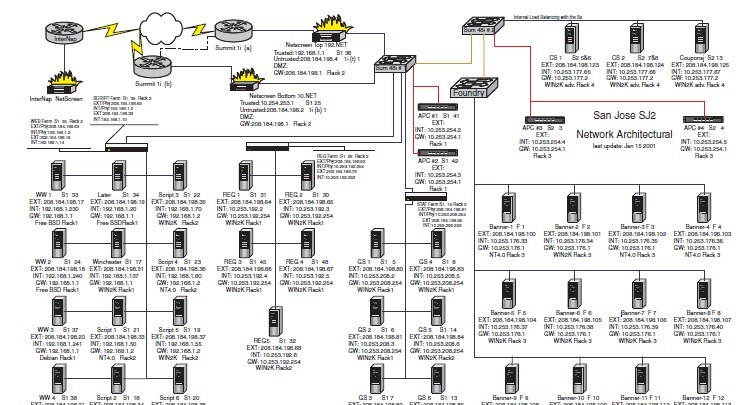
On the table was a schematic drawing of the new network layout: at the top was a blob, the internet itself, then descending the stack were rows of rectangles: from the firewall to the load balancers to the Linux servers and under these a battery of database servers.
Prior to Aperture Priority, Mitchell has little experience in networks; he had worked in application software, and all technical details were restricted to Windows or Macintosh operating systems. With more products and services done in and through a web browser, Mitchell expanded his technical repertoire to learn about colocation facilities, DNS propagation times, and LAMP stack servers.
Whenever possible he tried to map software technology to the real world, and he thought of networks as a highway system: data packets were like cars on the road, a road which might be fast or slow, and have various processing points along the way. Of course the metaphor was imperfect: a network was more dynamic and complicated than a highway.
Each layer in the drawing as well as its communication with the other layers, represented a potential problem source. If there was a glitch, where to start the troubleshooting and how to walk back the problem?
While waiting, Mitchell emailed Heidi Greene, who handled all technical support. She was offsite, in Medford, Oregon. He had met her at his previous company, where she was a lead in a technical support group. She agreed to work for Mitchell at Aperture Priority with the condition that she could work remotely. He agreed, but told her she’d have to help out with testing, in addition to her responsibilities for technical support.
Heidi responded immediately to his email: she was ready to dial in to any conference call if needed.
That was his team; he refused to add staff until he was confident about the company’s future. For the product documentation, since it was only a web site service, there was no need for the getting started guides, user manuals, or any of the other traditional software documentation. He and Heidi wrote all the online help, frequently asked questions, and how tos.
As Scott talked about the roll out plan, Mitchell wondered about how it would go. Scott worked long hours and wrote a lot of code, but was careless: he’d mark a bug as fixed, but it wouldn’t be fixed, and only after two or three attempts did the fix finally take. Other times he’d forget to do something: tell another developer about a change he was making which might affect someone else’s code, or push out new code and forget to include a critical file. Mitchell wasn’t a programmer, but he could evaluate the ability of a developer by how well the code ran. Perhaps Scott just needed a better manager, someone who could help him be careful and make fewer mistakes.
Scott had joined the company after Jacob had been working on it for six months. Jacob, as a new programmer, had relied on Scott for technical help. Soon Scott had hired another developer, Eric; the two of them had previously worked together at travel web site in Pasadena.
When he had interviewed at Aperture Priority, Mitchell first met with the company founder Jacob. They talked for less than ten minutes.
“Look,” said Jacob, “we need testing, badly. We should have done this months ago. Henry speaks highly of you, and that’s good enough for me. You need to meet the developers, but they should be no problem. When can you start?”
Mitchell liked Jacob right away: he seemed modest, even shy, yet he had the confidence to start Aperture Priority. In Mitchell’s experience company founders were the neither shy nor modest. Jacob was about twenty-five, had been a photographer who taught himself programming so he could build his own photo website. Eventually he had given up photography all together to focus on programming: one thing had lead to another, until the personal site had become a business.
After talking with Jacobm, Mitchell met with both Scott and Josh. It had been a bit of Jekyell and Hyde: Josh asked only a few questions, very good questions, the kind that could not be answered in a sentence or two, but instead required giving background, circumstances, and outcomes. Scott had asked many questions: when and how sqa would log bugs, about how long a typical testing cycle lasted, and who could see bug reports. Scott seemed concerned that SQA would report to Henry, and not to him; Mitchell wondered if Scott had ever worked with an SQA group before.
~
At 2:00 A.M. Wednesday morning Pacific time, the developers began the upgrade.
Josh started by redirected all incoming traffic to a web page that advised users that the web site would be down for a few hours for maintenance. After waiting fifteen minutes, Mitchell and Heidi confirmed that they could not get to the regular web site, but instead were directed to the temporary site.
As they waited for Scott and Eric to push the new code, Didier and Nash walked into the office. Like Scott and Eric, Didier and Nash had moved with the company from Burbank to Palo Alto. Mitchell wasn’t quite sure what they did. Their titles were senior marketing manager and senior business development manager, but Mitchell thought they were too young to be senior anything. He thought of them as Jacob’s entourage—they seemed to have their jobs by being friends with Jacob, rather than the customary prerequisites of education and experience. Nash and Didier were nice enough, and like the others from Burbank, favored bowling shirts or Hawaiian shirts. They had been out at a bar, had seen the office lights on, and stopped in to see what was going on.
After about an hour Scott said, “Okay Mitchell. We pushed out the changes to one of the servers. I emailed you the server address, can you guys take a look?” Scott said he needed to get home, but would be checking email. Eric disappeared with Didier and Nash.
Mitchell forwarded Scott’s email to Heidi, then got to work. It was already 2:55am, and that gave them about an hour to test everything. As often happened, there was limited time for testing, and because testing was the last engineering process before new code went live, the entire company watched and waited on the test team. He and Heidi had already tested the new server code when it was running on his test server, but in Mitchell’s experience, sometimes the code he tested was not the same code that got pushed to production.
Mitchell had three computers: two running the Windows operating system and one was a Mac. Heidi had two computers, one with each operating system. On one of the Windows computers he started a series of automated tests: he changed a few parameters to target the test server, then launched it. The automated tests checked the basic operations of Aperture Priority: creating a new user account, uploading photographs, creating albums, deleting photographs, and so on. It was the sanity test, to ensure existing features and functions had not broken by the new server code.
After that he began testing the list of changes Scott had written in the change log. He logged in to one of his test accounts, and looked at his albums: the first one he opened showed pictures of what looked to be college-age girls wearing not a lot of clothes. What the hell was that? Another album contained pictures of a college Spring break trip to Fort Lauderdale: young people, drinking beer in every picture, in a hot tub, on a beach, and at a dance club. None of those were pictures from Mitchell’s account.
He logged out of that account and tried another of his test accounts. Here the albums looked like they had been created by someone who was Amish, or perhaps since electronics were forbidden to them, then Mennonite: there was only one album, and it contained thirty pictures of quilts. Mitchell logged out of that account.
His test accounts should have only his photographs: many pictures of Rene and baby Isabelle, and photographs from their life before the baby: vacations to Hawaii and Tahoe, and pictures of family visits in Santa Barbara and Barre. None of his albums contained pictures of teenagers, parties at the beach, or quilts.
Mitchell looked over at the automated tests that were running – so far these were running without any error. It looked like new accounts were working okay, but if an existing user tried to view their photos and albums, they could end up seeing the images from someone else’s account. Why hadn’t they seen this when testing the new server code on the internal servers?
Just then an email came in from Heidi:
Mitchell,
I’ve been looking at the new server and it looks like there is a problem with existing accounts. Instead of seeing my albums with pictures of all my cats, dogs, horses, and kids, I’m seeing pictures of a middle school trip to Washington, D.C., and another of someone remodeling his house in Nebraska (I think).
Something’s really wrong.
What are you seeing?
Heidi
Mitchell talked to Josh and Henry about the problem, then sent an email to Scott. Twenty minutes later there was a reply.
All,
I think I found the problem. The proxy server was configured to cache our pages for 30 days. This could explain the users seeing another user’s album (if a user was behind a proxy, they may have been seeing another user’s album since the page was stored in the cache – the url for the get_code page is recycled for all users).
Scott
Senior Software Engineer
The cache setting, how often the browser requested new information from the Aperture Priority site, at thirty days was problematic, but he thought the fix was easy. Mitchell was less sure about recycling a URL to be shared among all users, he’d have to check with Josh about that. Mitchell wondered why they had not seen this problem while testing.
“What time is it?” asked Henry.
“About 3:30…make that 3:35.”
“Shit. All right, we’re out of time. We need to postpone the upgrade and rollback any servers we changed. The East coast is starting to wake up. Josh, send email to Scott, then help him make sure we revert back okay. Mitchell, you and Heidi check after they’re done to make sure the site it still working fine. We’ll have to wait and try again next week.”
~
The next afternoon Henry called a meeting to review what had happened.
“Gretchen is concerned about the problems we had last night with the server upgrade. We’re trying to get another round of funding, and we want to make sure everything is working smoothly.” Gretchen was the chief executive officer. Mitchell had only seen her in the office a couple of times; she often worked from her home, or was out at business meetings, attending conferences, and conventions.
Scott had investigated and confirmed what Mitchell suspected: the servers the team tested with were configured differently from the production servers. Scott fixed the problem, and everything should be fine for the next upgrade.
The following week, at 2:00 A.M. on Wednesday morning, the team began the second upgrade attempt. Forty-five minutes later Josh gave Mitchell the okay to start testing. Ten minutes later Rene walked in with Isabelle, who was asleep in the detachable car seat carrier. She saw the look of panic on his face.
“Relax. I couldn’t sleep, and she was awake, too, although she fell asleep as soon as I started the car. We thought we’d keep you company. Don’t worry, I brought some work to do, I’ll just sit down here next to you.” Rene had brought her laptop computer, and set it up at the table next to Mitchell.
A little later Rene asked Mitchell, “Who are those two guys over there?” She nodded towards Scott and Eric.
“Do you like their cool bowling shirts?”
“No, yes, I like the shirts. It’s just I’m not used to seeing developers who wear rub on tanning lotion, that’s all.”
Mitchell smiled and went back to testing. This time the upgrade seemed to be going well. His automation tests had not reported any errors, and his existing test accounts all looked okay. He clicked on one photo, a picture of Rene, taken under a flash, from a dinner party a few years ago. It was then Mitchell noticed something new in the menus.
“Hey guys,” he called out to the room, “I thought we were still working on the red eye removal feature, and weren’t going to make it live until we did some more testing on it.”
The engineering team had been working on adding a few simple photo editing tools, one of them was the red eye removal tool. Eric had been working on this feature, and walked over to look at Mitchell’s computer.
“Shit, I think I merged the wrong branch of my code into production.”
Scott and Henry walked over to Mitchell’s computer, Eric was at his own computer, typing intently.
“Well, we could just call it beta and leave it out there,” said Scott.
Henry glanced at Scott, then shook his head. “No, I don’t think so. Let’s not use the beta label to cover sloppy work. No, it’s twenty-six until four. Let’s revert the changes. Sorry guys.”
After Rene left, while Mitchell waited for the developers to rollback the servers, he palmed and squeezed the chunk of granite and thought about the Pareto rule. He had taken just one economics class in college, and had only a rudimentary understanding of the Italian economist’s concept of twenty percent of the people controlling eighty percent of the land. Did that apply here? In his experience, a few engineers out of the larger group were the most productive.
Mitchell wasn’t sure how much code Jacob still wrote. Scott wrote a lot of code, but also made so many errors that his performance was below average. Eric did not write a lot of code, but as a percentage he made as many mistakes as Scott. Only Josh was competent.
To stuff it into Pareto: if 20% of the people did 80% of the work, was it possible that 80% of the problems were caused by 20% of the people? But that wasn’t quite right. What if 80% of the people were causing all of the problems? What if your team was a statistical aberration, the majority were bug writing, process deficient engineers?
~
The following week the team met on Wednesday night instead of Tuesday. There had been a delay in getting all the features done and tested, so the team decided to delay until Wednesday. Mitchell had wanted more time to test, but that would have meant releasing Thursday night, and Henry did not want new code going out on a Friday.
Mitchell was tired. Earlier that evening he and Rene went out to dinner with Barry and his fiancé, Anne. Barry had worked with Mitchell and Rene two companies ago, and had been in their wedding. Barry had eventually left that company to join Apple, and had worked there for over four years. Dinner that night was at the Los Altos Bar and Grill; it was their first outing without Baby Isabelle.
Everyone ordered the ribs and Barry ordered a bottle of Mayacamus.
“Well, I think you’re buying now,” said Mitchell as he glanced at the wine prices.
Barry and Anne had met at Apple, were going to be married at Pebble Beach next month, were looking at homes in Menlo Park.
While Anne and Rene talked about the baby and the upcoming wedding, Barry worked on Mitchell.
“I told you, you should have come to Apple three years ago, but you wouldn’t hear of it. You and your boner for start ups.”
“Barry, don’t be crude,” said Anne.
“The point is there is more than one way to the top of the mountain. Or getting the best return on your work. Listen, I get the start up thing, we worked at one together.”
“Yeah,” said Mitchell, “but it’s not just getting a lot of stock, it’s also getting in on the ground floor of something -”
“Online photo albums? Come on, you should be aiming higher.”
“Okay, we’re not splitting atoms or curing cancer, but it is useful.”
“Right, sorry. Look, there are interesting things happening at Apple, too. Just come on over and talk. I’ll set something up.”
Barry ordered another bottle of Mayacamus. After the waiter had refilled all their glasses, Anne joined in. “Rene mentioned about the pressure she got at her company when she announced she was pregnant. That’s horrible. Apple has a much more generous policy, and it’s paid. Also the father’s get paid time off, too, although it’s not as long. I think six weeks or so.”
“And how is it you know so much about Apple’s maternity leave policy” said Rene. Anne didn’t answer, just shrugged and smiled.
“Look, Apple shares are up over thirty percent since I joined, and it’s stayed there. Part of it was luck, my timing of when I joined. But also….things are happening, I don’t think the share price is going down for a while.”
Mitchell said nothing for a moment. He tried and failed to control a feeling of envy for Barry and his good fortune. He realized he should be happy for his friend, but Mitchell could only think about what he had missed out on, even if he’d never had any interest in working at Apple.
“And you know what else? It’s those perks that a big successful company offers. Like Anne said, one is the maternity leave policy. You want to know another? The employee stock purchase plan. Remember those? You just never appreciated the benefits because all the companies you work for aren’t public and therefore don’t have ESPPs.”
The ESPP was a program in which Apple employees could opt to buy Apple stock at 15% discount off the current market price. In the same way that contributions might be made to a 401(k) retirement program, an employee could set aside a certain amount of cash to buy Apple shares. Twice a year a stock purchase was made, at the discounted price, and then those shares were deposited in the employee’s brokerage account.
“It’s pretty good there,” said Anne. “I worked at a small company before Apple, and I enjoyed that: getting to do a little bit of everything is fun. It won’t be quite the same, but the good salary, stock plan, and benefits are great. But that’s enough of this sales talk – we sound like we’re recruiters. Let’s order coffee because poor Mitchell has to go back to work after dinner.”
“Yeah, you poor sod,” said Barry with a smile, “but listen, I don’t want you to leave too soon or have any regrets. Give me a call when the time’s right. You’ll know.”
After dinner he had driven directly to the office. The developers were just starting the upgrade, and feeling like he ought to sleep he a little, he called out to everyone, “Okay. I’m taking a nap until you all are done.” With that, Mitchell pushed his chair aside, and laid under his desk, using his computer case as a pillow. He was asleep within in three minutes.
He awoke twenty minutes later, and sat cross legged on the floor for a few minutes until he was fully awake. At 2:30 A.M. he and Heidi began testing. In addition Henry was there, helping them check all the changes, along with Scott, Eric, Jacob, and Josh. Didier and Nash had even come in, and were testing the new site on their computers.
An hour later the team took a break and Henry surveyed their results. A couple of problems had been found, but one was hard to reproduce, and there other was not considered serious enough to stop the roll out.
“Okay people, that’s a wrap. Third time’s a charm. Let’s see, it’s twenty-five before four. Let’s push out to all the servers, check that all systems are update to date, then redirect traffic back to the production site, and we’re done. It’s been a great Thursday morning.”
~
Mitchell woke mid-afternoon on Friday; prior to that he was not sure how long he had been up: since the start of work Wednesday morning, through dinner with Barry that night, then the server upgrade into early Thursday morning, working all day Thursday and Thursday night, until finally just after midnight Friday morning.
He wanted to sleep more, but he knew he had to get up right then otherwise it would take a week to get back to a normal sleep cycle.
Still in his boxer shorts, he walked into the kitchen. There was coffee in the stainless steel metal press, and he poured a cup and put it in the microwave. Then, because it was the afternoon, and a Friday, and because of everything he had been through, he opened a bottle of beer, and put it next to his coffee, alternating one drink with the other. He switched on his laptop, which was on the kitchen counter. As it booted up, he looked out the window over the sink: a marine layer had moved in after midnight and it had cooled off in the morning, and now the afternoon air was absolutely still and dry, and he could see clearly the serrated edges of the incandescent green leaves on coral bark maple Rene had planted late last fall.
When he had returned home Thursday morning after the successful server upgrade, just after 6:00 A.M., he had checked his email before going to sleep. There was an email from Gretchen:
Team,
We have received take down notices from the Corbis Corporation, which owns the rights to the Ansel Adams collection, the Bettman Archive, and the Getty Collection. Apparently users have been uploading images from these collections, which is in strict violation of licensing and copyright law.
Why didn’t we know about this sooner?
Henry – can you call a meeting to set up a plan for fixing this? We need some way to ensure that users have the rights to all the images they upload.
Since we don’t have in house counsel yet I’ve asked the board for a recommendation regarding representation.
Gretchen
CEO Aperture Priority
Under the current system users confirmed that they owned the rights to the photographs they uploaded by clicking a check box with a legal disclaimer. But the honor system was archaic in the internet era, and clearly the check-box hadn’t stopped anyone from uploading any photos, regardless of ownership rights. Ensuring copyrighted material was not uploaded would be difficult: the number of images uploaded everyday was in the thousands, maybe tens of thousands images.
Henry had called an engineering meeting that morning, although he delayed it until 10:30 A.M. because of the late night. Mitchell had taken a shower, dropped baby Isabelle at Mary Jo’s, then gone to his favorite greasy spoon for breakfast, his theory that when tired the best way to stay awake was to keep eating: at Baji’s cafe he got the huevos rancheros, adding extra hot sauce to the eggs and black beans. After finding parking six blocks from the office in a residential part of Palo Alto, as he walked to the office he bought a large black coffee and two scones. Once his normal schedule resumed, he’d have to put in extra time in the gym.
The remainder of Thursday was a blur of meetings: an engineering meeting about the take down order; a working lunch with sandwiches brought in from Togo’s; a conference call with a lawyer; then finally a long engineering meeting exploring ways to identify copyrighted photographs, and prevent their being uploaded. For this last problem they explored ways of vetting photographs prior to uploading, everything from hiring low paid workers in the Philippines to manually review all photos—the team considered this a financial and logistic nightmare—to writing code to programmatically examine facets of an image, weather it was for a watermark, copyright symbol, information in the EXIF data, a survey of the primitives in the photo itself, or some other sort of pattern matching; any one of these a considerable technical challenge.
When Mitchell got home just past midnight, Thursday into Friday, it was hot and stuffy in the house. Rene was asleep on the couch, baby Isabelle in her basket on the floor, and a fan was set up just a few feet from them. A note from Rene said that the toilet had backed up, and could he take a look. The hot weather had made the bedrooms too warm to sleep in, but in the living room there was a cross breeze, and he put a light blanket over Rene and checked that Isabelle was comfortable.
He put on some old shorts, it could be a messy job, then spent two hours unclogging the toilet. He tried the plunger and flushing, but the bowl always filled right to the rim with water, sometimes a bit of water sluicing over onto the floor. Then he went into the garage and found a metal snake, and worked that around for a while. He rummaged under the kitchen sink and found some chemical clog cleaner, then poured that down the toilet and waited for a while.
While he waited the baby woke up, and Mitchell splashed the upper part of his body with hot water and anti-bacterial soap, heated a bottle for her, and spent the next thirty minutes walking back and forth as she sucked on the bottle. Despite his stress and lack of sleep and the clogged toilet, right then and there, his wife asleep near them, holding his daughter, everything was fine. He wanted more moments like this.
At three-thirty in the morning it started to cool down, baby Isabelle went back to sleep, and a few minutes later, he heard the sucking sound of the toilet clearing.
Too wired to sleep, Mitchell checked his email, and saw a note from Josh asking him to look as some competitive sites, and to try uploading a copyrighted photo, perhaps Ansel Adams’ “Moonrise Hernandez,” to see what, if any, filtering these sites might do. He spent the next four hours, until dawn Friday morning, swapping emails with Josh as they tried different scenarios.
Mitchell’s last email was to Henry explaining what he and Josh had been working on, and that he’d probably be working from home that day.
Now on this clear, beautiful Friday afternoon, drinking coffee then beer, beer then coffee, he logged into his work email account. While he had been asleep forty-four emails had come in: forty-three were on the same topic: the thread had started when Heidi had forwarded a message from a customer who was unable to view any of her albums. The responses were from Scott, Josh, Eric, and Henry. There was also one email from Gretchen: he read that one first.
Team,
Here’s the latest on the series B funding. I’ve been busy talking to about eight different VC’s, but right now only four are really in play.
BCP Technologies: Jerry Berg, an associate, called to say they were going to pass. I don’t think he really got it, so I’m going to see if I can work a back channel into one of the senior partners.
R70: I spoke with Melissa and they are interested in investing, but are just too busy to get to us right now. Very interested, but very busy.
Merrow and Jenkins: Met with Dave and Mark and they want in, although there is work to be done hammering out a price and other terms.
FIFO: They were a part of our previous bridge round of funding and expressed interest in the B round. I have a meeting with them tomorrow.
Gretchen
CEO Aperture Priority
To Mitchell this mean that only one of the VC’s was in play, not four. And that one looked uncertain.
His index finger traced a circle on the trackpad, the cursor orbiting Gretchen’s email.
He had a lot of stock, much more than all his previous companies, combined. He would never have this much stock again. But a million times nothing is nothing. The company was a long way from…anything. It wasn’t real until something happened: if Aperture Priority went public, and the stock price stayed high enough after the employee blackout periods so he could sell at a decent price, or some company acquired them.
He put that aside for a moment. He clicked on the last message in the long thread.
Hey guys,
I made a fix directly on the production servers, and am now seeing a massive spike in cpu utilization, and the servers are slowing down, becoming unresponsive. Stay tuned while I look into it.
Scott
Senior Software Engineer
Mitchell’s mind went sideways. What the hell? There was too much going on. What was that quote? He pulled The Mythical Man Month from his shelf, and opened up to the chapter: Adde parvum parvo magnus acervus erit: add a little to a little, and there will be a big pile.
He looked at the clock. It was twenty-six, twenty-five to four, but this time not in the morning, but afternoon. It was time.