Third in an occasional series with Lindsey Munro. Previously:
~
The offer letter from Madison Medical Technology arrived by email. The human resources manager wrote that the company was also sending a paper copy to her home address, and that it should arrive in a day or two. They looked forward to a favorable reply, very soon.
Lindsey Munro printed a copy of her offer letter, and took it in to her husband, Jim, who stood at the sink using a metal spoon to scrape burned pasta from the bottom of a pan. He rinsed, then dried his hands, then started reading through the letter.
Just as they sat down at the kitchen table, there was a knock on the front door, the sound of it opening. “Hello? Anyone? It’s Kate.”
“We’re in the kitchen, come on in.”
Their next door neighbor, joined them at the table. “Bob’s working late—it’s the end of the quarter and the whole finance department is pulling an all nighter. Do you have any glasses? Here’s his latest concoction. It’s actually drinkable this time.” Kate held up a dark green, unlabeled wine bottle.
“Five weeks’ vacation to start?” said Jim looking up from the letter. “Hi Kate, sorry, I’m just reading through something of Lindsey’s. Grab some glasses from the cabinet.”
“Hi. Five weeks! Wow! That looks like an offer letter. Is that right? Haven’t you been talking to that company for months? Finally! Congratulations!”
“All employees get five weeks’ vacation. It’s a Swiss company, that’s why the vacation is so generous,” said Lindsey. “Some employees start off with six week, but I think that’s if you’re older. Hang on while I go check on the kids. It’s too quiet.”
Lindsey returned to the kitchen a moment later. “Roy is reading to Jennifer. It’s pretty cute. They should be okay for a few more minutes.”
Jim handed the letter back to her. “Looks good to me, but there’s nothing about stock options here.”
“Are they publicly held?” said Kate. “If so, then maybe there’s some sort of employee stock purchase plan. Or if they’re a Swiss company, then maybe they trade on a foreign exchange, but I’m not sure how that would work for you here.”
Lindsey held her wine glass at the base of the stem, and swirled the red wine around for a moment. She noted a bit of sediment in the bottom of the glass, then tasted it. Kate was right, Bob’s wine was pretty good this time, finally. “Look, it’s not like a start up or anything like that. I had a long talk with the hiring manager after all the interviews were done. It was pretty interesting. And different.”
Three months ago Tracey, Lindsey’s recruiter, had called her. “Hi Lindsey, Tracey. I’ve got something a little bit different and wanted to see if you were interested. There’s a medical devices company that has an opening for a senior release engineer. Gotta like that title, right?”
“Medical devices? Uh, hmm…well, I never considered anything like that. Aren’t they subject to all sorts of regulatory guidelines?”
“No idea. Maybe, but in looking at the job description, it doesn’t say anything about prior experience in this particular field. But they do want an experienced release engineer.” Tracey read the job description to Lindsey.
A release engineer worked on software development teams, and was responsible for all the source files, code libraries, and other digital components that went into making a software release. She was in charge of building versions for testing, versions for production release, and if appropriate, international versions translated into a variety of languages. Because release engineers dealt with many departments and personalities, the job required the technical skills of a programmer, the organization of a librarian, the ruthlessness of a Mafia boss, and the patience of a diplomat.
After learning a little more about the company, Lindsey told Tracey to send them her resume. “One thing I need to tell you,” said Tracey, “they move very slowly in the hiring process. Sabrina, the human resources manager there, told me this. She said it often takes a couple of months, and she wishes it was faster but that’s just how it is. She was very polite about it, and told me to pass that along to you, and she hopes you’ll be patient enough to last through it all.”
Two weeks later Sabrina had contacted Lindsey for a phone interview, and three weeks after that she went into the offices for a series of interviews spread over two days. Madison’s offices were in a technology park in Sunnyvale. The lobby was large, its furnishings vaguely Scandinavian, with a long wooden receptionist desk to one side, and a seating area opposite. The receptionist checked Lindsey’s name against a list, asked her to sign in, and gave her a visitor’s badge. As she waited, Lindsey made a strong coffee at the small metal espresso machine in the seating area.
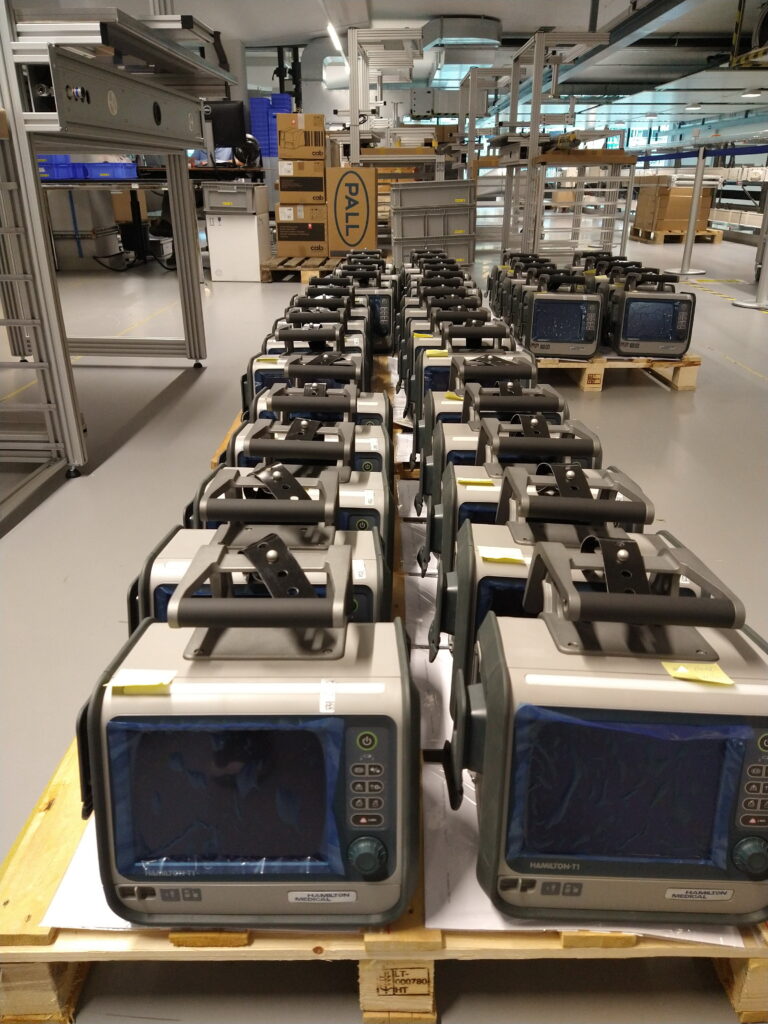
A few minutes later a slim, older woman came out and introduced herself as Sabrina; her English had the slightest accent. They spent the next hour in a conference room, talking about employment at Madison Medical. Sabrina asked Lindsey about what kind of company she liked working for, what was important to her, what her salary expectations were, and if she had questions about the company. Sabrina gave a bit of background about the company and its benefits. The company made a variety of mechanical ventilators, designed for intensive care units, operating and emergency rooms, and for emergency medical technicians out in the field. The company had been started by an engineer from the United States and a doctor in Switzerland, and had an office in each country.
“Sorry to interrupt you, Sabrina, but what is your first language? I thought French and German were the languages in Switzerland.”
“They are, but so is Italian. I’m from Lugano, in the south, near Italy. So at home I grew up speaking Italian. But I also speak French and German.”
“And English, of course.”
Sabrina smiled. “Yes, and English.”
“Any others?”
Sabrina smiled, “Well, some Spanish and a little Mandarin, too, but neither of these very well.”
Lindsey wasn’t so sure about that. Sabrina asked one last question, about going from a company like Adobe to a medical devices company.
“Honestly I hadn’t thought about medical devices until Tracey contacted me. At Adobe I worked on some pretty interesting software products, but that was all in the retail or consumer market.” Lindsey paused a moment, thinking about why she had liked Adobe. “Still, we made software that people used: artists, photographers, and others. I’d like to continue that, even if it’s in a different domain: making technologies that people find useful. Certainly that must be true of ventilators.”
After talking to Sabrina, Lindsey met with Florian, the director of software engineering, and Rick, one of the software developers. Florian looked to be in his mid-forties, and Rick might have been a few years younger than her. She had spoken with both during the phone interviews. This meeting was for her to ask them questions about Madison’s development process. They spent the next hour talking about source code control systems, the firmware upgrade process, and all the many issues of providing a software and hardware solution. She left that afternoon; it seemed too long since she had been in an interview where real issues had been discussed.
The second day she arrived at Madison’s office at eight. She had two meetings that morning, then would give a presentation about a particular problem in the afternoon. Her first meeting was with Anita, a former respiratory therapist who had joined Madison and become a product manager. She spent an hour introducing Lindsey to the operation of one of the ventilators from an end user point of view. After a short break she then met Ulrich, who had worked at Madison as a mechanical engineer for six years before becoming a project manager. This second presentation was a different view of a ventilator, this one technical: the ventilator as an assembly of hardware, firmware, and software.
After lunch at a nearby cafe, Florian asked Lindsey to present to a group of hardware and software engineers her plan for adding a new ventilator to the current digital library, or source code control system. She asked a few questions about the theoretical new device, wrote a couple of bullet points on the white board, then said, “Well, assuming this new ventilator is similar to an existing one, then I’d simply leverage the existing system, I mean there’s no reason to re-invent the wheel, especially when there’s already a framework and process in place for the other ventilators. There might be some differences, but I’d assume that existing processes and tools would address eighty, ninety percent of what’s needed: repositories, check in procedures, branching, labeling, and tagging, and so on.” She paused and looked at Florian for a moment. “Is this a trick question, it’s just too simple and the answer seems obvious.”
He laughed. “No, it’s not a trick question. Yes, you’re right, the solution really is quite simple, but you’d be amazed at some of the answers we’ve received.”
For her next task Lindsey was asked to roughly outline the process for migrating all the engineering software assets from one source code control system to another.
“Just keep it at a high level,” said Rick. “I don’t think we’re going to actually do this, although we’ve thought about it a few times.”
“I know what you mean. It’s a big project. We did something similar years ago at Adobe, when we moved over to a system by Clearcase. It took much longer than expected, but once it was done everyone was glad.”
She paced up and down for a moment, then started writing on the white board. “Okay, here we go, in no particular order.” She listed a set of assumptions, dependencies, and risks, then wrote out a series of steps for the project.
Rick asked about the problem of having to maintain two source code systems until the migration was complete.
“Unfortunately that’s the nature of the beast, until you’re confident about the new system being in place, and you’re ready to abandon the old one. Yeah, it’s a double effort for a while, but we can’t shut down our business while we do our internal projects. But if you plan well and know what you’re doing, hopefully the period of two systems is very short.”
Lindsey paused a moment, looked at what she’d written on the board, then said, “Well, anyway, I’m sure I did leave off some steps. At Adobe we had four or five people over-seeing the project, it was that complicated. No one person knew everything, and it took a team brain to get it all done.”
After the meeting Florian stayed behind, and the two of them talked in the conference room.
“Florian, I wanted to ask you something. The company didn’t ask me to sign an NDA.”
Florian smiled. “Do you think we should have?”
“Well, I did get product demonstrations from Anita, and a bit of a technology overview from Ulrich. But maybe all that information was already publicly available. Still, I was a little bit surprised.”
“Well, perhaps that’s more a question for the legal department, but I think we like to give people the benefit of the doubt. By that I mean if by chance we did reveal something confidential during the interview process, we trust that the candidate would treat that information with discretion. And the interview process is onerous enough, there’s no need to further complicate things by making someone who’s not even an employee yet, sign a legal document.”
Lindsey had been struck by the range of ages at the company, with many people there looking well over fifty. Did they have any interns?
“Our main office in Lausanne does have a program with local educational institutions,” said Florian. “While it’s not quite like it is here, there’s a university, and some partnerships. Anyway, we do get some software and hardware engineers in for internships although they are usually for a minimum of six months. We’ve found shorter periods don’t work very well. And we also work with students who might be studying medicine, or respiratory therapists also.”
Florian paused a moment, then asked Lindsey if she had more questions.
“So, how’s the company doing? Have there ever been layoffs? Is the company ever going to go public?”
“I’ll answer the last question first and the answer is no. There’s a profit sharing plan, but the company will never be going public. We approach things a little differently here. Layoffs? That doesn’t happen so much with Swiss companies, or at least it’s very rare. Maybe sometimes in the financial sector, Swiss banks, you know. But never at Madison, and the company has been around for thirty years. And please believe me when I say the company is extremely profitable.”
A week after the interview Lindsey received an email from Sabrina, stating they had two more candidates to interview, but a decision would be made within three weeks.
Now they were sitting in the kitchen, looking at the offer letter.
“So they didn’t ask you any of those stupid questions?” said Kate. “What’s that one you told me about at the other company? About manhole covers? When your first thought that was some sort of butt plug!”
“Oh god,” said Jim. “For someone so brilliant….I’ll have to tell you about the time I told Lindsey we were going to a Gaelic Festival, and she thought that was something in the Castro.”
“Nope,” said Lindsey, frowning at Jim. “They didn’t ask me about manhole covers. You didn’t need to mention that, Jim. They didn’t ask me about pirate booty. And they didn’t ask any other useless questions like how many ping pong balls fit into an airplane.”
“But did they ask you to play ping pong?”
“No, thank god.”
“What about those other things that are all the rage? The CEO at Bob’s company says they need to buy a foosball table and start having beer bashes on Fridays. Are those listed as a benefit in your offer letter?”
“No, none of that. No nap rooms or candy walls or video games. Oh, but you wouldn’t believe the family leave benefits. It’s too bad we already had our kids. I almost want to have another, just so we can take advantage of the benefits.”
“Ah, I love you a lot, babe, but I think not,” said Jim.
“But honey, if you worked there, you’d get a lot of time off, too. It’s not just the mother. But yeah, if we had three kids we’d have to go to a zone defense, and one on one is better.”
Outside it was dark already, signs of late fall. Lindsey had been on the interview circuit since July, and she was glad it was finally over. She had expected there to be more interesting opportunities outside of Adobe, and was disappointed that there were so few. Sabrina had indicated that they expected the new release engineer to start at the beginning of the year, giving her enough time to give notice and wrap up her current responsibilities; this would be her last holiday party at Adobe. She shivered a moment.
“Are you cold, Lindsey?” said Kate.
“No, it’s not the cold.” She felt the mix of excitement and anxiety at the coming change, like her first job after graduating from college: she was leaving the world as she had known for so long, now moving beyond that. But she also felt a rare moment of insight and contentment, a quiet sense of herself. It was an earned happiness. She thought about the companies where she had interviewed, she compared them to Madison Medical: most were frivolous, to work for them would be…demeaning. She was glad she waited.