The cure for anything is salt water – sweat, tears, or the sea.
~ Isak Dinesen
Four weeks ago, Carole, in human resources, contacted me: I still had over three weeks of vacation time, and it must be used by the end of May (my vacation year is from June 1 to May 31st). A moment after reading her note, I realized that over the past year I had not taken much vacation, and then felt it all at once: an accumulated psychic constipation from not taking time off, the long hours (I work much more than the standard French thirty-five hour week), and the Americanization of my company that had previously very Swiss. All at once I had to get out, immediately.
Layered under the immediate urge to suddenly get away was the awareness that I need to do what I can, while I still can. Get out while you can is the message in a Jansport advertisement from a thirty year old issue of Outside magazine (see the photo gallery below). Advertising is interesting: it’s meant to sell us something, and yet in doing so, the message sometimes makes real, confirms what we already feel.
I convinced Carole to let me take two of the weeks in June, so I could join Annie in Chiang Mai. The rest I would have to take before the end of May. After thinking about if for several seconds, I decided to go someplace I had been, a long time ago.
Outbound: 1984 and 2026
While studying in Heidelberg in 1984, during the February break, I bought an Interrail pass, then traveled north. My destination was Helsinki, to visit friends, but along the way I visited Copenhagen and Stockholm. The trip was wonderful, but the days in Denmark, Sweden, and Finland were cold, and daylight hours still short. Germany had been also been cold. Dark. Cold. Enough. After a week in Helsinki, I opened up the Interrail map to see what could be done: the warmest place I could go on my Interrail pass was Morocco.
The next day I started out. I traveled straight back to Heidelberg, spent a day doing laundry, then started for Morocco. From Heidelberg I traveled to Paris, changed train stations, took the train to Madrid. From Madrid I bought a sleeping berth, and when I woke up, I was in sunny, warm Algeciras. I took the ferry across to Tangier, then the train to Rabat.
Forty-two years later, travel within Europe has changed. Many former Soviet dominated countries are now available for travel on an Interrail pass: the Czech Republic, Poland, etc. Morocco is not. That didn’t matter. When I saw there was a direct flight from Montpellier to Agadir, I knew that was the one. Agadir is on Morocco’s Atlantic coast; I’d be out of France and in a very different country; I booked the flight out for Friday, May 15th.
Mid-life crisis
In April, 2003, I started surf lessons at Club Ed in Santa Cruz. In April, 2004, I bought a used 9’ Agua surfboard at the Half Moon Bay surf shop, having already bought my own wet-suit (a 4/3) two months before, at O’Neil’s in Santa Cruz. In time, I acquired more gear: a wet-suit for slightly warmer water (3/2), and another board, as 12’ Micky Munoz Super Glide, which could function as a long board or be used for stand-up paddling. At that time, there were almost no boards made strictly for stand-up paddling.
I surfed at the easy places in Santa Cruz, around Ocean Beach in San Francisco, and a few places in Marin County, across the Golden Gate. I was never any good, the longest rides being ten seconds, all on small waves. It didn’t matter; I had always liked being in the ocean, the salt water, and one short ride after being out for three hours was enough to keep me coming back. There’s something utterly amazing and magical about riding a moving wall of water.
We brought the surfboards when we moved to France, but I have not yet used them. It bothers me. When working in the yard, I walk by where they are stored; they’d call to me, but I have no answer. In the garage the Pohaku paddle, used for stand-up paddling, leans against the wall, lonely, a pretty girl with no dance partner.
Since being in France; I had done a lot of swimming, some skiing, a bit of sailing, but no surfing. With Annie and Catherine away, the boys busy with work, and my company telling me to take time off, now was the time to get away.
Surf house
A Reddit recommendation lead me to the website of Sunshine Surf (link below), and their byline sealed it: Surf ‘til you drop. On May 8th I reserved a private room, May 15th – 22nd.
Corentin, French and looking like an archetypal surfer dude, ran the house, where I arrived Friday evening, after a forty minute cab ride from the Agadir airport. The outside courtyard was a large patio with trellis to shield the sun, with a small pool off to the side. On the ground floor were the office, kitchen, and a large eating area. Next were two floors of rooms and bathrooms. The rooftop was a large open terrace, with views to the west.
Everyday was breakfast at 0800, leave at 0900, search for the best place to surf. Two hours of surf instruction in the morning, then lunch on the beach, then free surf time in the afternoon. We were back at the surf house before 1700, then dinner about 2030. The food was very good, and on hand was an excellent harissa paste, and there was always hot mint tea with sugar.
Fellow travelers, local surfers
In all the planning for the trip, I hadn’t given any thought to who else would be at Sunshine Surf. I might have noted in passing that all the web site pictures featured people much younger than me, but it didn’t register. It didn’t matter. I was going to clear out my head, not socialize. And they were much younger, the youngest being twenty-four, and most were under thirty-five. I just needed to remember that among the young, I needed to comport myself a bit differently than if with my peers; I’ve been here before – see here.
Patricia and Frederick were from Quebec (city). Patricia has traveled and been to other surf camps, but for Frederick, the trip to Morocco was his first time on a plane and the first time out of Canada. Frederick was a roofer who severely injured his knee in an accident; he had nearly finished retraining for a new job, and had some time off. I was sorry when they left – they were going on to Marrakesh, then to another surf camp further north.
Milan was from Germany, in his early twenties. He was an accomplished cross-country skier, and although he had never surfed, took to it right away. In his spare time he sketched using oil based sticks, and worried that in the heat they would melt as they were stored in a metal tin. Milan had an strong resemblance to a close friend from high school, David Berg. David was an excellent athlete (football and wrestling), played the guitar, and like Milan, had a low key, yet intense disposition and easy going personality. David died two years ago from complications of a stroke suffered many years ago.
There was a steady stream of German surfer women: Martha and friend, Miriam, Lena, Devya, and Katarina. All were young professionals, all had previously been to surfing camps.
Katarina was from Leipzig, and she was by far the most fit. She worked out either in the morning before surfing, or went to a club afterwards. Me – the morning session had been more than enough, never mind anything else. On my last day, Katarina said she was unhappy with her surfing that morning. I replied that if nothing else, she had a good work out (conditions were a bit rough, and a strong current meant a lot paddling just to stay in the same place). She said no, it was not a training day, it had been her rest day. Right.
There were others: two French university students studying law; an English hair stylist; two Irish brothers, one a civil engineer and the other a software programmer; a young couple from London, both physics majors, one worked for the government, the other in the private sector; an American digital nomad; a man from Spain living in Annecy.
The local surfers were tolerant, even polite to these white, unguided missiles, filling up their waves. I remember one surfer: he could catch any wave, and even if it looked like not even a wave, just a ripple. When he paddled back out, his arms never moved (or at most he just paddled a few strokes with one arm), yet his surfboard moved easily and quickly through the water. It was the same on the day he had a long board, and another day with a short board (both were painted the same: mostly a white/cream color, with the front tip of the board painted black). Another, a boy maybe fifteen years old, skinny and wearing a goofy hat, surfed expertly on a long board. He’d give some tips to the pretty blonde, tell me I had the right of way on a wave, and said thank you when I let him take it.
Morocco
Morocco reminds me of the American west, Wyoming or New Mexico: muted colors over cruel terrain, long vistas and sightlines But here, there is the added benefit of this harsh and beautiful landscape butting up against the Atlantic Ocean – so wonderful.
I don’t care for the subordinate role of women in society, but I did like the interactions of the men I saw, which was mostly surf guides talking with other surf guides. There was always a greeting, a bro-chest hug, then the slightest hand over the heart. I don’t know if that’s a custom of only Morocco, or all of the Maghreb or informed by Islam, but there is a grace and sincerity about it that I’ve never seen anywhere else.
Salt water
If you’re not good at something, a twenty year pause and three knee surgeries will not make you better. If I was smart, I would have planned ahead for this trip, giving myself a few months to train and prepare for the surfing: lifting, endurance training, and most of all stretching, especially the hips and knees. Instead I was coming off a cold, and had only been back to the gym for a few days. I don’t let not being smart nor prepared stop me.
Sunshine Surf is run by Reda, who is from Agadir. In addition to being a former pro-surfer, he seems to have some sort of tech background, and gets around in Arabic, French, English, possibly Spanish, and does a very funny Swiss German imitation (I work for a Swiss company, so I’ve heard Swiss German).
Every morning Reda and his coaches would discuss a bit of technique on the beach, then we’d paddle into the water. There they’d push you into a wave, tell you when to stand (for me that meant when to fall down), yell at you to not look down, but always look up, which way to point. As soon as you paddled back out, they told you to turn and paddle hard, right now, to catch that next great wave coming in. Repeat. Every now and then, to keep their sanity, a good wave would come through and all the coaches would paddle to catch it.
On the first day, after struggling to get into my wet-suit not worn in twenty years, we went out in windy conditions. On that day I was cold. Corentin, who looked at my wet-suit like an archaeologist finding some old relic, mentioned that the technology today was much better, and wet-suits were warmer. But I was cold only on the first day. The following days were fine. Conditions were such that we had to surf at the same spot, except for the last day. The last day was a Half Moon Bay sort of day: cool, lots of fog, low visibility, slightly rougher seas. I mostly got rolled and took a few on the head, and although strong, the waves were not high. I viewed it as part of the conditioning and training.
Homeward bound
In late February, 1984, I began the return trip from Rabat; I was nearly out of money, my Interrail pass was due to expire, and classes were starting. The return route was the train from Rabat to Tangier, ferry to Algeciras, then trains to Madrid, Valencia, Barcelona, eventually over Basel, finally back to Heidelberg, all spread out over several days, spent either on the train or sleeping in the train station. While on the ferry from Morocco to Spain, looking back, I thought about coming back some day.
May 22, 2026. On my last day, I went to the coffee shop Devya recommended, then to the lunch place the British lady coffee shop owner recommended, Machi Mouchkil. Elsewhere I bought bracelets for Annie and Catherine, and pinky rings for Kieran and Andre. I flew the 17:22 flight Transavia from Agadir to Montpellier, just over the three hours. Looking out the window, the landscape was colored tan, brown, faded red; the terrain was brutal and mesmerizing. Here and there was a occasional thin ribbon of green, indications of a stream. Again: I need to come back; I’ve got that white guy attracted to North Africa syndrome. I landed in Montpellier around sunset, and was home by 21:45.
Bill Evans, sunset over the Atlantic
The second to last night, before dinner, I had the rooftop terrace to myself. Generally I prefer the quiet, just to take in the sunset, but I had my phone, and put on Bill Evan’s Peace Piece. The days were starting to get hot, but around sunset the breeze picks up, and you need a sweater when on the terrace.
I grew up swimming in the Atlantic, at Bethany Beach, Delaware. It’s one of the places I miss the most in the United States. There, you see the sunrise, now I was watching the sunset. For the past week I had again been in the Atlantic, not much real surfing, but instead mostly swimming with a surfboard attached to my ankle. That didn’t matter. What was important: I’d found a salt water cure; a lot of living compressed into a short time, that cleaned out the accumulated lint from my brain and soul. Brined and tired, lucky and grateful. Get out while you can. ‘Til you drop.
Links
Sunshine Surf House is here.
Machin Mouchkil is here.
Bill Evans Peace piece is here.
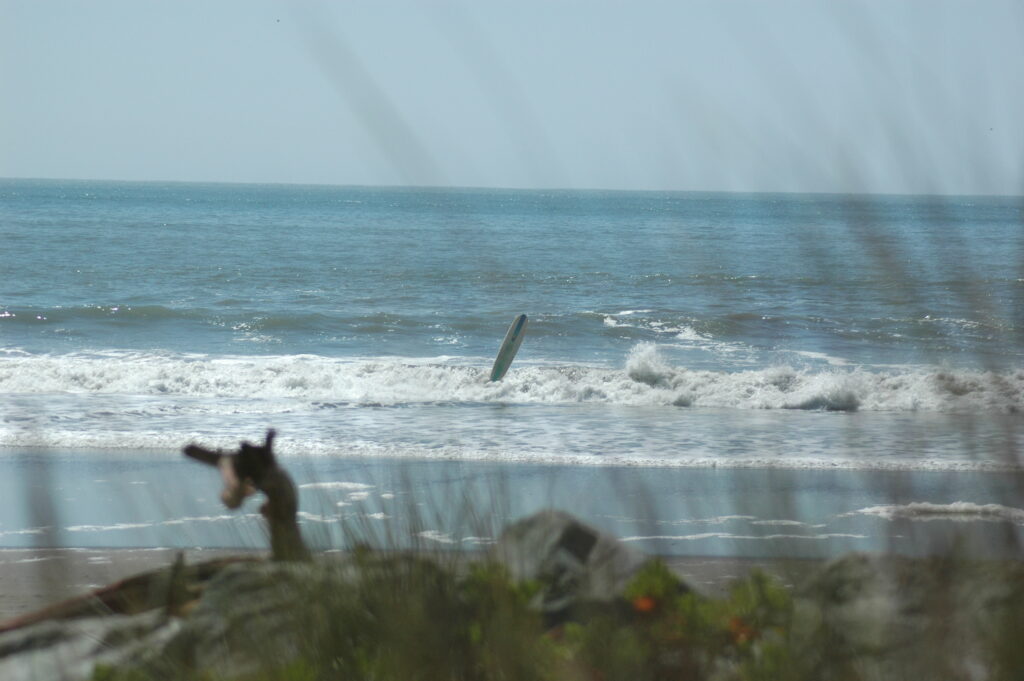
The featured image photo is the writer’s surfboard, post wipe out, near Stinson Beach, 2007. He’s under water somewhere.