What’s the word
According to the American Heritage Dictionary, the origins of the word vacation are from Old French, then further back to Latin: from the past participle of vacāre, to be empty. Empty, as in vacate. Staycation, a term that never existed before 1992, has no classical pedigree. Neither word applied to exactly, nor were there an applicable related terms: package tour, retreat, pilgrimage, walkabout, trek, sabbitical.
On our first trip to southeast Asia, 2017, it was a bona-fide travel vacation: six weeks traveling to Laos, Cambodia, Thailand, and Viet-Nam, traveling by boat, train, and bus, never more than a few nights in each destination, seeing all the sites. This time I went directly to Chiang Mai, and once there, stayed there; no temples, no museums, no lady boy shows. Go + stay + cation? Whatever the word, it was two weeks of Saturdays in Chiang Mai.
Things that go Thai: language, boxing, food
Annie and Catherine had a simple routine: for about six weeks, went to Thai language classes in the morning, then to a muay thai boxing gym in the afternoon. For meals, they ate everywhere, in full size restaurants or four-table back alley kitchens. Every once in a while, indulging in her culinary weakness, Annie took Catherine to KFC, where the recipes have been localized: the fried chicken is much spicier and flavorful than that found in North America. My routine when I arrived was a bit simpler: up in the morning, work out or read, yoga in the afternoon, night markets in the evening.
The people you meet
Like a box of chocolates, you never know what you’re going to get.
On the plane from Bangkok to Chiang Mai, the passenger next to me introduced herself as Tuppence. She saw my look and explained that on the island off the coast of Scotland, where she was born, a child is named before birth, and that in addition, there’s some sort of nickname that is also applied, hence the Tuppence. I haven’t go that quite right, but I had been traveling for over 24 hours and not slept.
Claire, her real name, was a vetrinarian, and traveling for Chiang Mai to volunteer on a farm for two weeks. She would then travel back to Europe to meet with her husband. He was a Canadian, who had studied zoology, and now traveled the world as a consulting apiarist, brought in by governments, NGOs, or similar communities to help rebuild the beekeeping ecosystem.
At In Come Muay Thai boxing gym, I met Claudio from Chile, and Gabriel, from Houston. In Texas, Gabriel had practiced MMA (mixed martial arts), and had moved to Chiang Mai to train full time in muay thai boxing. He split his time between Thailand and Viet-Nam, and loved being in southeast Asia. When he learned where I lived, Gabriel said he had passed not far from Montpellier while on the Camino, one of the pilgrimage routes to Santiago de Compostella. He’d been inspired to make the walk after reading Paulo Coehlo’s The Pilgrimage. Not what I expecting from a Texas MMA guy at a Muay Thai boxing gym in Chiang Mai.
Meanwhile, in her Thai language class, Annie and Catherine had met students from Germany, Japan, England, France, China, Cambodia, and the United States, including a quiet young woman from Alabama, Eva. Annie reported that during a class, while learning words to describe tastes and flavors, an argument ensued about what foods were spicy, what foods were savory, and how best to describe ginger. Spicy to someone from France might just be savory, or even bland to someone from southeast Asia. Someone mentioned wasabi, and the man from Cambodia said that on a trip to Japan he had tried wasabi, and did not find it spicy.
Unexpectedly, Eva spoke up and asked him if he had ever tasted pure wasabi.
He had not.
She paused, then the normally quiet Eva replied, Southern accented, “That shit will fuck you up.”
Routines and observations
Last time here we got aroung in tuk-tuks, but that’s now so 2017. Today it’s Grab, and we usually took scooter/motorcycles (one for Annie, one for me), as these could weave through traffic and get us there quickly.
Not in France 1: During the two weeks, despite traffic being much denser, I heard car honks just twice. Twice. Around us in Montpellier, a car honks every minute.
The majority of tourists were from China, and of these, most were young women over-dressed in white frilly dresses, phone cameras out, always filming themselves and their friends.
Not in France 2: at the gym, when someone is done at a station, all the weight plates are put back where the belong, and the benches are wiped down.
Half of all the plastic waste in the world comes from Thailand. Here’s why: when you order your first Thai iced teas of the day, the first of at least three, it comes in a plastic cup with a plastic lid and a plastic straw in a plastic bag.
Riding in a cab to the Bangkok airport, I passed billboards advertising breast enhancement, health care clinics, and special retirement visas to those who qualified.
Several times we passed bars where there were old white guys with much younger Thai woman, often a white paw resting on her butt. Thailand is a popular source of mail order brides, although the bar scenes looked not be looking for something long term, but instead short term transactions.
Not in France 3: the people are polite.
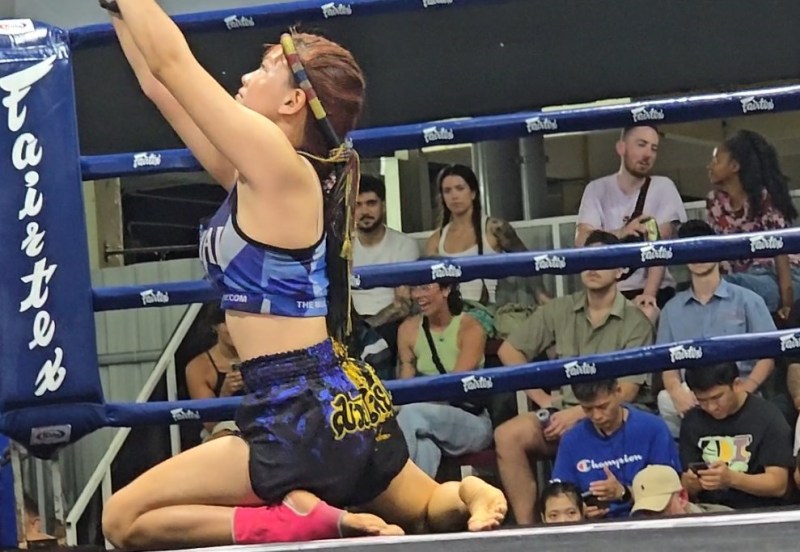
Every night there are amateur boxing matches at the Fairtex arena.
Retail therapy
I made two trips, each lasting over an hour, to the Lost Books Shop, before deciding to buy seven books. The decision process took time because I was constrained not by money, how rare, but instead luggage weight. Annie had asked me to bring an extra, nearly empty suitcase, so we could bring back gifts. The limit would be 23kg, so I had to plan carefully. In the end the list included W.H. Brand’s biography of FDR, Willa Cather’s Death Comes for the Archbishop (I had read long ago, but lost in one of many moves), the very disturbing, yet fascinating The Kindly Ones by Jonathan Littell, Boris Pasternak’s Dr. Zhivago, and last and definitely least, Mary Renault’s The Last of the Wine, set in Athens during the Peloponnesian War. I thought TLOTW would be in the same league as Marguerite Yourcenar’s Memoirs of Hadrien. It wasn’t. Renault’s book is about men wrestling, men being oiled or otherwise lubricated, men being wiped down after wrestling, and so on, all in anticipation of the main character’s soon to occur, but never to be read by me, pederasty. I didn’t make it past page fifty.
By chance while in the China Town of Chiang Mai, we wandered in to the Si Tong clothing store. One thing lead to another, and after several more visits, I had three tailored shirts and two tailored pants, all in linen. That all sounds extravagant, but it wasn’t. The materials and labor were embarrassingly cheap, given the heat where we live, linen is by far the most comfortable fabric. Annie came away with not less than five pieces of clothing.
A while back I lost my wedding ring. It probably came off at the gym, where between sweating and variable finger width (lifting versus at rest), it would be easy for it to come off. Thinking this would be a good occasion to get a new ring, I found Sirilak Samanasak (Boom) and her Metal Studio. My new ring was silver, with a hammered pattern, Annie got the same, one as a band, the second as a wrap around ring.
Poverty compared
In May I spent a week in Morocco, in Taghazout, an hour north of Agadir. I loved the harsh, arid landscape against the cool green of the Atlantic, and certainly preferred Morocco to the tropics of Thailand. Thailand and Morocco are both poor countries, dominated by one religion, governments are a sort of constitutional monarchy, and both are popular tourist destinations. Unlike Morocco, Thailand was never a colony: the monarchy negotiated unfavorable trading with the European powers to maintain its independence.
Despite their similarities, there was a meanness to the poverty in Morocco, something I did on feel in Thailand. In Morocco there were piles of trash, dogs running everywhere, a sense of abandon.
Chiang Mai has its shared of smells, utility wires running every which way, and outdoor laundry mats; but there was not the constricted feeling I had in Morocco. Back alleys would be cluttered, but there were no stacks of trash. In the Lost Book Shop, bookstore, old women would pull books off the shelves, dust them off, then put them back on the shelves. There were brooms for sale everywhere, and you’d frequently see someone sweeping.
What accounts for this? North Africa versus Southeast Asia? Islam versus Buddhism? Status as a former colony? Thailand’s culture – politeness? A bit of all of this?
In Montpellier there is a large population of Moroccans, both recent arrivals and those here for at least one generation. Our next door neighbor is Moroccan. We’ve met him; he’s nice enough, at least to me, but Annie refuses to talk to him: he makes no effort not to talk down to women. His house is a dump: a trashed front yard, trees and bushed overgrown, smell of cat piss. He lives in Marrakesh, and rents it out now and then. He doesn’t give a shit. Would the house next door be in better condition, better maintained if the neighbors were not Moroccan, but Thai? I think so.
A nice place to visit
There are number of expats living in Thailand, and Annie has floated the idea of spending more time there. It’s not for me. Closer to the equator (Montpellier is at 43° 36′ nord versus Chiang Mai’s 18° 47′ nord – a distance around 2,700 km), the daylight hours are pretty much the same all year, as are the climate and seasons: not much variation throughout the year. I prefer living at higher latitudes: long summer days, long winter nights, four seasons, a variety of landscapes not so far from we live.